Free Shipping & Fast Turnarounds
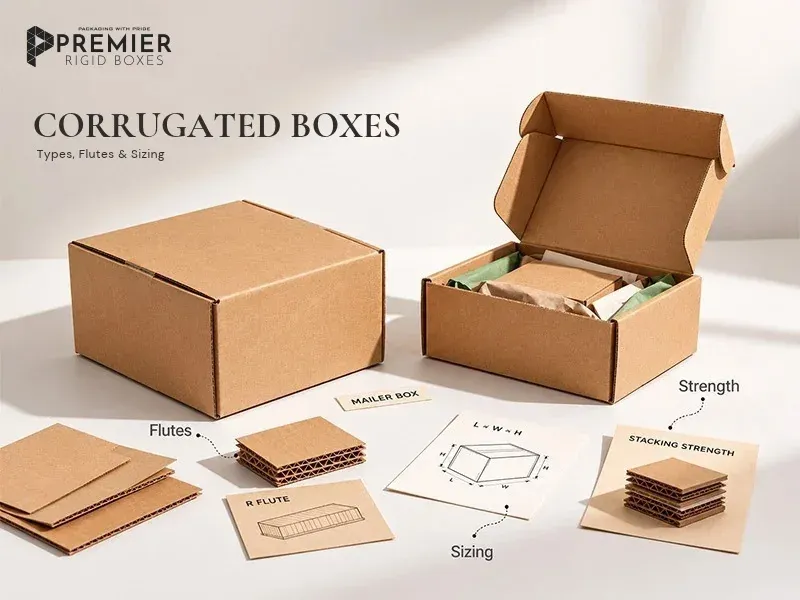
Most of the shipping damage that gets attributed to rough handling is actually a specification issue. You’ve got a box that’s too weak for the stack, one that’s too big for the item, or one that’s the wrong fit for the job. However, the solution is almost never a more expensive box. It’s the right box, chosen with care.
In addition, this guide takes you through how corrugated materials work, how to select a flute, wall, and style, how to read strength ratings, how to size a box without paying for air, and what to ask a supplier before you order.
A corrugated box is made of three layers of heavy paper glued together. These layers give the box the strength needed for shipping.
In other words, it is basically a paper sandwich:
That wavy middle layer has tiny arches or flutes that act like a cushion. This protects the items from bumps and drops. It keeps the box light to carry yet strong enough not to be crushed when stacked or dropped.
A cardboard box is just about any box you can think of, really, from a cereal carton to a shoebox to a shipping box. However, corrugated board is a specific material: a fluted paper between paper liners on both sides. In other words, that’s what gives a shipping box its stiffness and stackability. For example, a cereal carton is typically just a single-layer paperboard with no fluting whatsoever.
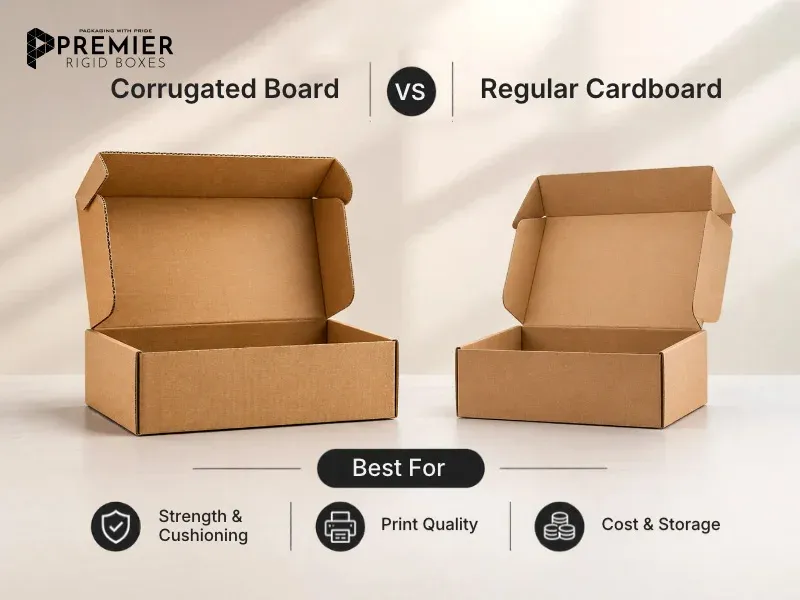
To clarify, in corrugated box design selection, the choice is between the final board structures, not the raw ingredients:
| Feature | Corrugated Board | Regular Cardboard |
| Best For | Shipping, heavy items, fragile goods | Retail shelves, lightweight products, inner cartons |
| Strength & Cushioning | High crush resistance and shock absorption | Low crush resistance; bends and dents easily |
| Print Quality | Basic graphics directly on brown or white kraft | High-resolution, colorful retail printing |
| Cost & Storage | Expensive; takes up more warehouse space | Cost-effective, ships and stores very flat |
In short, corrugated box manufacturers take corrugated cardboard made in the USA in three simple steps that turn wood and recycled paper into sturdy shipping boxes.
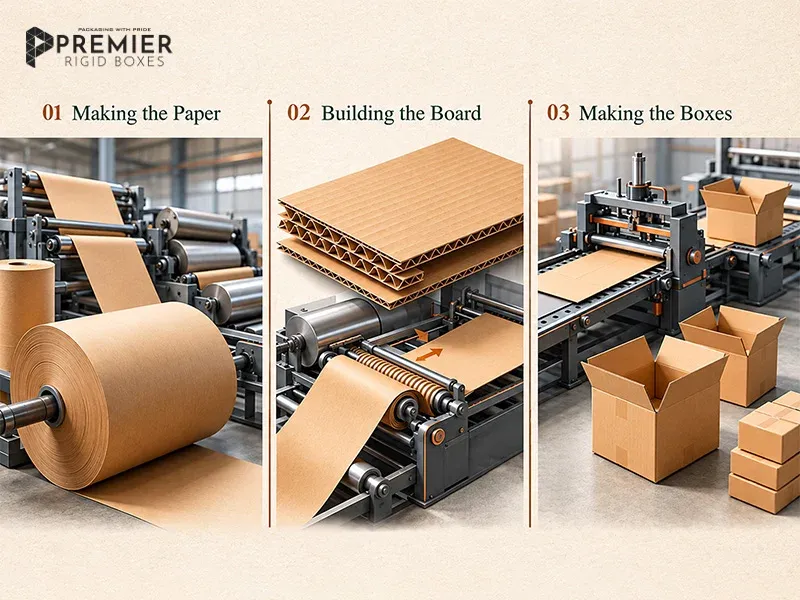
To clarify, these are the flat outer and inner sheets of paper. They protect the inside of the box, hold everything together, and provide a smooth surface for printing labels or logos.
Quick Tip: Most importantly, pay only for the white top if the customer will see the outside. However, for warehouse-to-warehouse freight, brown kraft or test liner does the job just as well for less.
Flutes are the wave-shaped medium between the liners. Taller flutes give you more cushioning and help handle heavy weight from above. On the other hand, shorter flutes provide a smoother surface for printing and hold up well against side pressure.
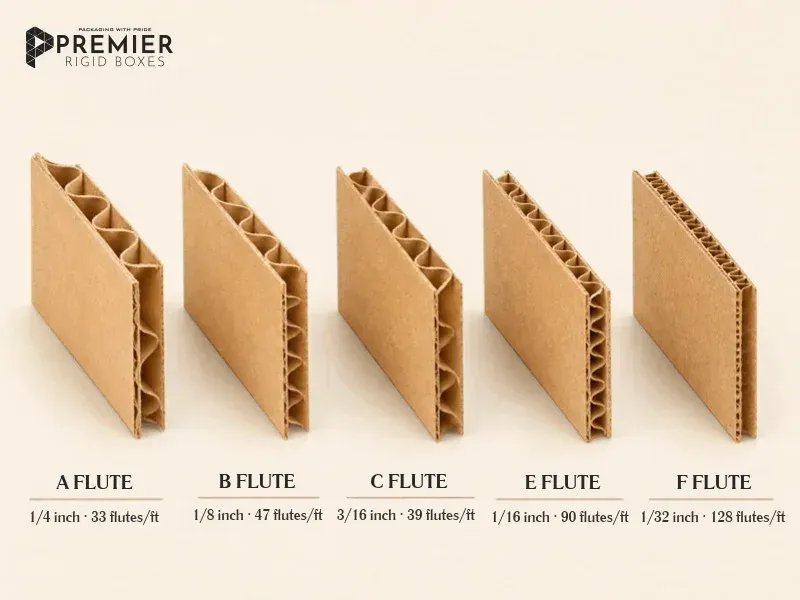
| Flute | Approx. height or Thickness | Flutes per foot | Typical use | Trade-off |
| A | 1/4 inch | ~33 | Cushioning, fragile goods | Bulky, rougher print surface |
| C | 3/16 inch | ~39 | General shipping | Not ideal for fine print |
| B | 1/8 inch | ~47 | Die-cuts, cans, retail | Less cushioning than A or C |
| E | 1/16 inch | ~90 | Cosmetics, small retail | Lower stacking strength |
| F | 1/32 inch | ~128 | Premium small cartons | Limited heavy-duty use |
Therefore, select the flute type based on your product weight, fragility, and stacking needs. Also, keep in mind that if your boxes go to store display, you will need a good presentation, which is provided by E- or F-flute, as it has a smooth surface for printing.
A custom corrugated box can also be made with more flutes and liner layers to support heavier loads. Consequently, the number of layers determines the type of wall, as discussed below.
Quick Tip: If the box will be shipped on its own, start with a single wall. However, if it’s going to be sitting under other loads for weeks, or if the product is heavy, go double or triple.
The FEFCO Code (European Federation of Corrugated Board Manufacturers) is the international standard system for identifying corrugated box styles using a four-digit number. To clarify, the first two digits define the main structural category, while the last two digits specify the exact box design.
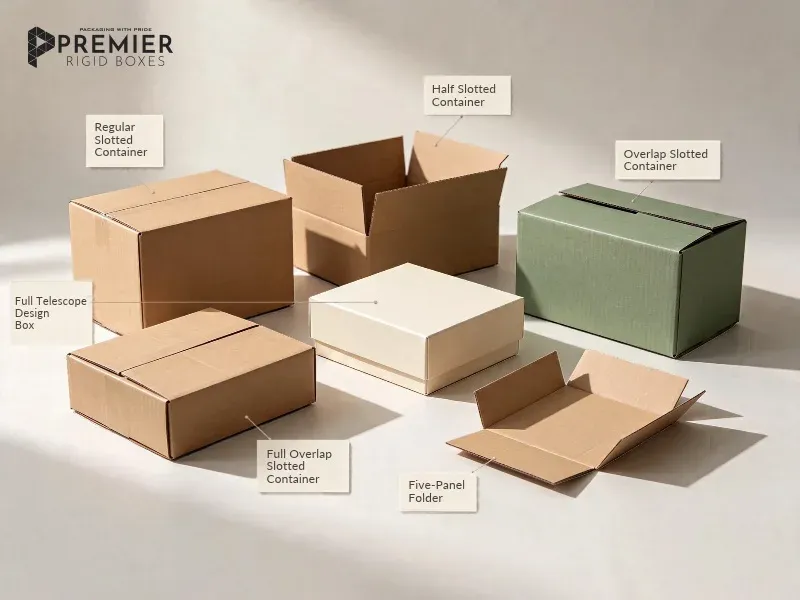
The classic brown shipping box with equal-length flaps that meet in the middle. For example, it is used for everyday shipping, moving, and general storage.
A regular box with an open top without flaps. In other words, flaps are only on the bottom. It is used in warehouse bins, open trays, or boxes with a separate lid.
Top and bottom flaps overlap by about 1 inch. So, it is used for boxes that need extra strength to stay closed.
Outer flaps fold all the way across the entire top and bottom. Therefore, it is used for heavy or fragile items that need extra crush protection.
A two-piece box where the top lid slides completely over the bottom tray. That is to say, these boxes are used for flat, heavy, or delicate items like framed art, mirrors, and files.
A flat sheet with five panels that wraps around an item and seals at the ends. Consequently, it is ideal for long, slender items such as fishing rods, blinds, or rolled posters.
| Box Style | FEFCO Code | US Industry Acronym | Protection Level | Downside |
| Regular Slotted Container | 0201 | RSC | Medium to high | Needs tape, limited retail appeal |
| Half Slotted Container | 0200 | HSC | Moderate | Lacks stacking stability, needs a wrapping cover for shipping |
| Overlap Slotted Container | 0202 | OSC | High | Difficult to tape and slower assembly |
| Full Overlap Slotted Container | 0203 | FOL | Very High | More material is required, and it is inconvenient to open |
| Full Telescope Design Style Box | 0301 | FTD | Very High | Expensive and provides slow assembly |
| Five-Panel Folder | 0410 | FPF | High for long items | Heavy tape usage and works poorly for bulky square items |
Choose ECT if you are stacking boxes neatly on pallets. On the other hand, choose burst if your boxes are being tossed around in individual delivery trucks or contain heavy, sharp items.
The Edge Crush Test (ECT) is the force in lbs/in required to crush a small strip of board along its edge. In short, because the walls of a stacked box carry the load edge-on, ECT is the best predictor of stacking performance and is therefore the key figure for palletized and stored goods.
The Mullen test measures how hard it is to poke a hole through the cardboard. In other words, it tells you how well the box protects heavy, sharp, or bumpy items during rough handling in transit.
The box compression test actually crushes the finished, assembled box. Certainly, it’s the real-world test, as all the other things that go on in the box (cuts, creases, glue joints, box shape) will reduce the strength as compared to a flat board.
The McKee formula is therefore a widely used estimate stating that compression strength is a function of ECT, box perimeter, and board thickness. To sum up, a taller or wider box will require a higher ECT than a smaller box carrying the same load.
| ECT | Typical use | Example |
| 23–26 | Light, non-fragile | Small apparel boxes |
| 32 | General shipping | Common e-commerce cartons |
| 40–44 | Heavier or stacked | Larger parcels, stacked goods |
| 48+ | Demanding freight | Industrial or palletized loads |
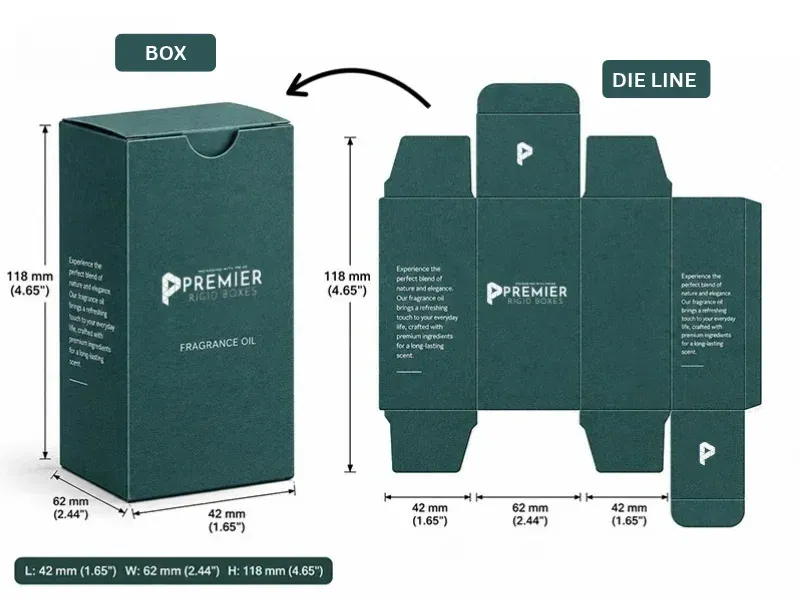
Firstly, the inside dimensions determine whether the product will actually fit. Meanwhile, outside dimensions are what determine freight and storage space. Most importantly, give inside dimensions in the order length x width x height (length and width are the dimensions of the box opening, with length being the longer of the two, and height is the depth).
Measure the protected product, not the bare product. Further, include the foam, the molded pulp, the partitions, etc. Therefore, leave just enough room for the insert, plus a small tolerance. As a result, any excess space will lead to movement and damage.
Box specification checklist:
For example, say you ship a 12lb set of ceramic cookware (12″ x 8″ x 6″) via a parcel carrier.
In short, the same product in the right box can reduce your shipping costs by nearly half. Above all, check the divisor with your carrier contract.
Standard boxes win on price and lead time. However, custom boxes and packaging win by eliminating void fill, reducing damage, cutting your dimensional weight charges, and carrying your brand. To sum up, if your annual spend on damage, void fill, and oversize freight exceeds the cost of custom sizing, then go custom.
Firstly, structural design, inserts, windows, handles, and tear strips generally serve a function. On the other hand, foil, embossing, and spot UV are predominantly there for the look. Therefore, you pick the features based on what they do for protection, for packing speed, or for the customer.
A corrugated box printing and finishing service turns plain boxes into custom ones, making them suitable for branding businesses and brands.
Coatings and finishes protect against scuffing. That is to say, the premium finish only really pays off where shelf impact is the driver.

Main cost drivers are board grade and flute, wall construction, box size, print colors and finish, order quantity, tooling and die charges, freight, and inserts/assembly labor.
Ways to lower cost:
Corrugated is by far the most widely recycled packaging material, with industry figures suggesting a high recovery rate in the US. However, it’s all very much down to the finished box, though. For example, wax coatings, heavy laminates, plastic films, and food contamination can all make a box non-recyclable, so don’t make any broad claims such as ‘100% eco-friendly’.
Above all, the best improvements are the practical ones: right-size the boxes, cut the void fill, use recyclable/re-pulpable coatings and adhesives, and, where possible, avoid mixing materials.
Questions to ask a supplier:
Corrugated packaging boxes are used by many industries requiring specific box strength and compliance.
Quick Tip: For general parcel shipping, a single-wall C-flute box at around 32 ECT is a good starting point. However, go up to 44 ECT or double-wall for heavy-stacked or humid storage loads. Go down to B or E flute if print quality and a thin profile are more important than cushioning.
First, figure out what your product is and measure its length, width, and height. Moreover, if your product is fragile or has a weird shape, make sure to include the size of any inserts you’ll need. Next, think about where your boxes will end up. Are they sitting in a warehouse, on a store shelf, or getting stacked during shipping? After that, pick the flute type and wall type that fit your situation. Once you’ve got that, just choose the box style you want, and you’re ready to place your order.
In conclusion, the right box will strike a balance among protection, transit conditions, branding, sustainability, and cost. Therefore, rather than going in blind, start with your product and your requirements.
Firstly, send us your product dimensions, weight, and shipping requirements, and we’ll recommend the right corrugated specification. Likewise, request a quote or a packaging consultation at any time.
Can I use a 32 ECT box to save money on bulk shipments?
Yes, for short trips with careful handling, a 32 ECT box can carry about 48 lbs. If the boxes will be stacked or handled a lot, choose 44 ECT. A damaged shipment costs more than the savings.
Can you certify boxes for ISTA 3A or ISTA 6A?
Certification is done by an independent testing lab. We help by designing the box for your product and adjusting it if the test fails.
What happens if my boxes get damaged in transit?
We find out why it happened, like a weak board or poor fit. Then we fix it with a stronger board, inserts, or a better size. If the box met your agreed-upon specs and still failed, we will work with you to find a solution.
Should I choose an RSC, FOL, or auto bottom box?
RSC is the most commonly used and lowest in cost. FOL is stronger for heavy or long items. Auto bottom is best for high volume because it sets up fast and looks neat.
How do I choose a flute for strength, shipping cost, and customer experience?
Use a C flute for a good balance of strength and cost. E and F flutes are thin, print smoothly, and give a premium look. A flute gives more cushioning but takes up more space, which can raise shipping costs.





 PRB - Admin